
In fifteen years of handling TDS compliance for businesses across Jaipur, we have noticed one pattern that never changes: deductors treat the TDS return as a formality until the penalty notice arrives. This year, there is an added reason to pay closer attention. The Income-tax Act, 2025 has replaced the old TDS return forms with new ones, and if your accountant or payroll software is still filing under the old form numbers, your Q1 return could be rejected outright.
This guide covers the exact due date for the Q1 FY 2026-27 TDS return, what has changed in the forms this year, and what it actually costs you in fees, interest, and penalty if you file late.
What Has Changed This Year
Starting FY 2026-27, TDS and TCS returns are filed under new form numbers prescribed by the Income-tax Act, 2025:
- Form 24Q (salary TDS) is now Form 138
- Form 26Q (non-salary TDS on residents) is now Form 140
- Form 27Q (TDS on non-residents) is now Form 144
- Form 27EQ (TCS return) is now Form 143
The due dates have not changed. What has changed is that the TCS return now follows the same quarterly schedule as TDS returns, instead of its earlier separate timeline. Section references used while reporting transactions have also been renumbered under the new Act – for instance, salary TDS is now reported under a different section code than the familiar Section 192.
If you deduct tax on contractor payments, professional fees, rent, or commission, expect the section code on your challan and return to look unfamiliar this quarter, even though the underlying deduction rules are largely the same.
This matters practically: a return filed on the old form number will not go through validation on the TRACES portal. It will not be treated as “filed late” – it will simply bounce back, and the delay clock keeps running until you file it correctly.
TDS Return Due Date for Q1 FY 2026-27
The Q1 return covers tax deducted between April and June 2026, on salary, contractor payments, professional fees, rent, commission, interest, and similar payments.
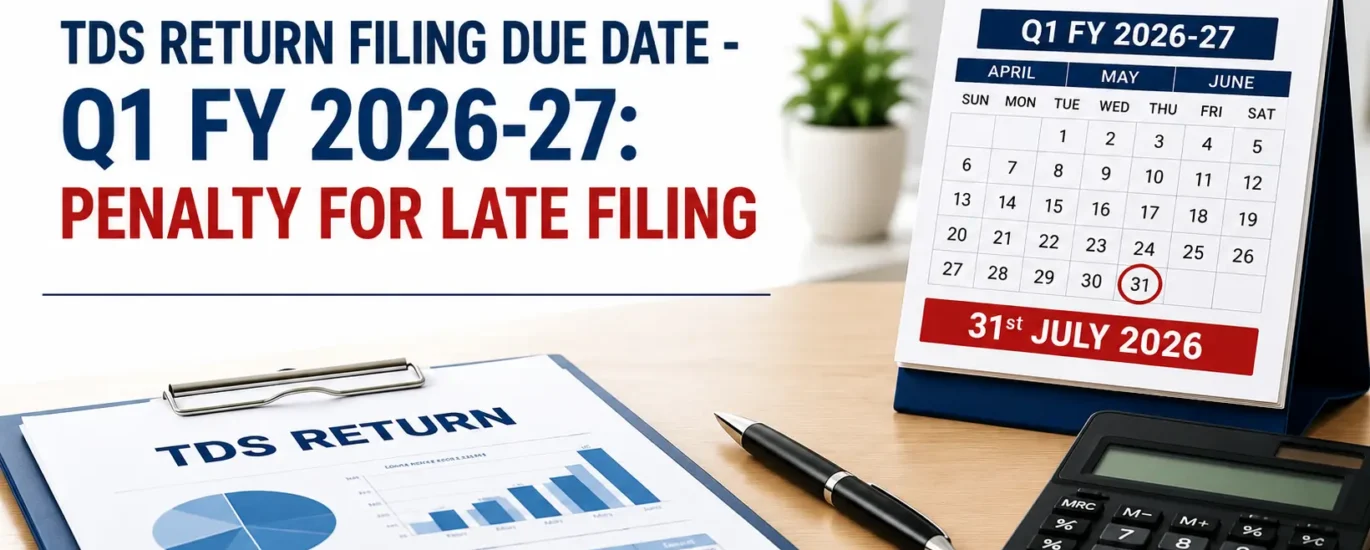
The due date to file this return is 31st July 2026.
This applies uniformly – whether you are a private company, an LLP, a partnership firm, a proprietorship, or a trust – as long as you hold a TAN and have deducted or collected tax during the quarter. There is no turnover threshold and no exemption based on business size. If tax was deducted, a return must be filed.
It is worth separating two obligations that are often confused. Depositing the TDS amount with the government is a monthly obligation, due by the 7th of the following month (with March being an exception, where the deposit deadline extends to 30th April).
Filing the TDS return is a separate, quarterly obligation. You can be fully compliant on deposits and still attract a penalty for a late return, or vice versa. Both need to be tracked independently.
Late Filing Fee Under Section 234E
If the return is filed after 31st July 2026, a late filing fee applies automatically under Section 234E – there is no discretion here, and no authority can waive it.
The fee is ₹200 for every day of delay, counted from the day after the due date until the day the return is actually filed. This fee is capped at the total TDS amount deducted for that quarter – it cannot exceed the TDS itself, which offers some relief for smaller deductors, but the fee still adds up quickly for anyone who delays by even a few weeks.
For example, if your total TDS for Q1 was ₹18,000 and you filed the return 40 days late, the fee works out to ₹8,000 (40 × ₹200) – payable in addition to the TDS already deposited, before you can even submit the return.
Interest for Late Deposit of TDS
This is separate from the late filing fee above, and many deductors confuse the two. If the TDS itself was deposited late – not just the return filed late – interest under Section 201(1A) applies at 1.5% per month or part of a month, calculated from the date of actual deduction to the date of deposit, not from the payment due date.
Note the “part of a month” language carefully. Even a delay of three or four days into a new month is treated as a full month of interest. A payment deducted on 28th June and deposited on 9th July, for instance, attracts two months’ interest, not a few days’ worth, because the delay spans across a month boundary.
TDS Return Filing Late Penalty Under Section 271H
Beyond the late filing fee, the Assessing Officer has discretion to levy an additional penalty under Section 271H, ranging from ₹10,000 to ₹1,00,000, for failure to file the TDS return within the prescribed time, or for filing an incorrect return with wrong PAN, wrong challan details, or incorrect deduction figures.
In practice, this penalty is not levied the moment you cross the due date – the return being one day or a few weeks late, once the 234E fee is paid, rarely escalates to a 271H notice. But prolonged non-filing, repeated errors, or returns filed only after a department reminder do increase this risk considerably. It is not something to test deliberately.
What To Do If You Have Already Missed the Deadline
If the 31st July date has already passed by the time you are reading this, here is the practical order of steps:
- File the return immediately, on the correct new form (138, 140, 143, or 144) – do not delay further while deciding on strategy, since the fee accrues daily.
- Reconcile challan payments, PAN details of every deductee, and section codes before submission – an incorrect return filed in haste often needs a correction statement later, which restarts part of the compliance headache.
- Calculate the Section 234E fee and any Section 201(1A) interest and pay these before or along with filing, since an unpaid demand shows up against your TAN later with additional interest.
- Keep documentation ready in case of a 271H query – a genuine, one-time delay with prompt correction is viewed very differently from a pattern of repeated non-compliance.
How A G A R & Co. CA Firm Can Help You
We handle TDS return filing for businesses across Jaipur every quarter, and Q1 tends to be the one clients underestimate the most, since it follows close on the heels of income tax return season. Our process starts with a challan and deductee reconciliation, followed by return preparation on the correct current-year form, and a final review before submission to catch PAN mismatches or section code errors that commonly cause rejections.
If your business is also due for ROC filing or GST return filing around the same period, we manage these together so nothing slips between the different compliance calendars you are tracking.
If you have already missed the 31st July deadline, do not wait for a notice – the fee only grows with each passing day. Reach out to us today, and we will calculate your exact fee and interest liability, and get your Q1 TDS return filed correctly within the same week.
Need professional help with TDS return filing in Jaipur? A G A R & Co. assists businesses across Sikar Road, Jhotwara, Murlipura, VKI Area, and Vaishali Nagar with timely tax and compliance services. From TDS returns to GST and income tax matters, our CA team helps you stay compliant and avoid unnecessary penalties.
